
Using Stoicism to thrive as an IC Data Scientist
tl;dr For Data Scientists facing lack of control over data and outcomes, Stoicism offers a framework to thrive in one’s career. By focusing on the “Dichotomy of Control,” individuals can prioritize what they can influence, such as the quality of one’s work, rather than external factors. Daily preparation and reflection enhance focus on what’s important, while embracing Stoic virtues (wisdom, justice, courage, temperance) and viewing career milestones as “indifferents” provides a path to a fulfilling and virtuous professional life, regardless of external circumstances.
The last year brought a series of job changes, a period of professional turbulence that’s all too common in tech. It was an experience that could have been defined by stress and uncertainty. Instead, it became an opportunity for growth. The difference-maker wasn’t a new technical skill, but an ancient philosophy: Stoicism. Here’s how I used its core principles to navigate the chaos.
The problem: a lack of control at work
Your model is technically brilliant, but the data pipeline is a mess. Your analysis uncovers a game-changing insight, but it’s ignored as a result of organizational politics. You spend a month building a tool that ends up being shelved due to a ‘shift in priorities.’ If this sounds familiar, you understand the core frustration of being a data scientist: a near-total lack of control over your outcomes.
As an individual contributor and a knowledge worker, you cannot guarantee a significant impact at your company no matter how diligent or competent you are. And you must also weather macroeconomic shifts and technology cycles in a job market shaped by layoffs and AI automation.
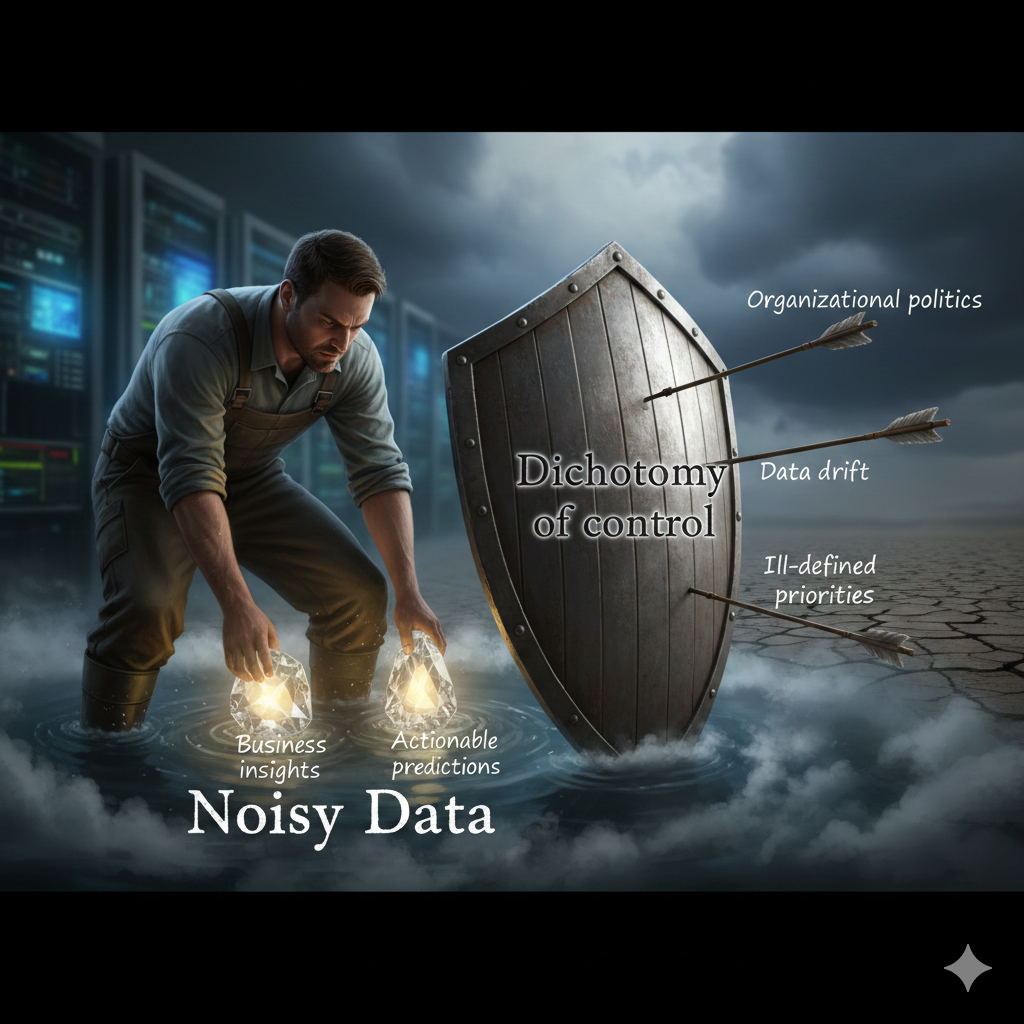
 IC Data Scientists often feel they are trying to make a silk purse out of pig’s ear. [Image credit: Gemini]
This lack of control is especially apparent in the domain of Data Science. For example, practitioners are rarely in full control of the data they require for their models. They typically have much higher quality standards than other data consumers within their company. And so they can face trying to “make a silk purse out of a pig’s ear”. Even when a data scientist is able to craft a useful insight from noisy data, they cannot mandate the adoption of data-driven decisions, given shifting business priorities and organizational politics.
I myself struggled with some job changes last year, and faced burnout and a lack of motivation to struggle through a limited job market.
The solution: refocus on what we can control
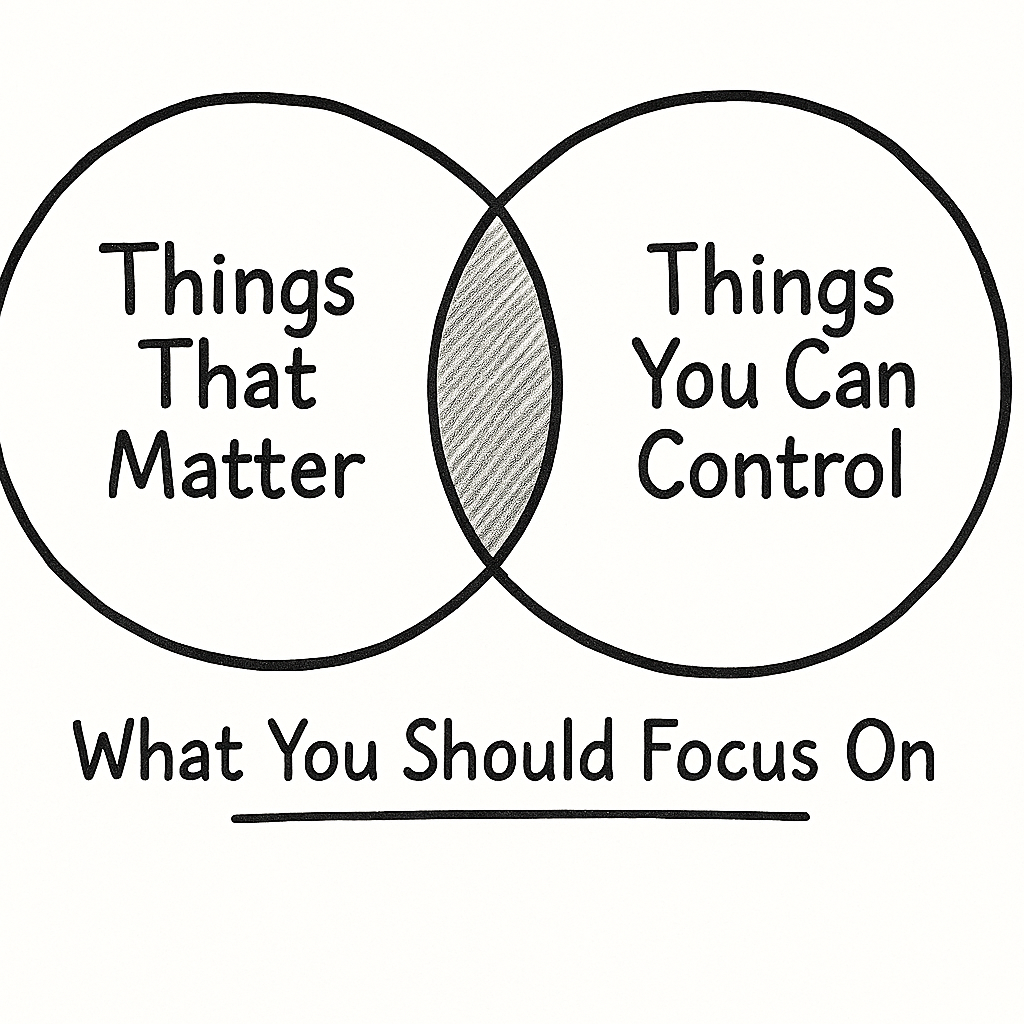
Instead of obsessing over what I could not control, I tried to apply the Stoic philosophy I had recently learned: accept that I cannot control these external factors, and instead focus on what I can control. This is known as the Dichotomy of Control, and can help Data Scientists thrive in a field defined by uncertainty. It provides a practical strategy for sustaining focus, integrity, and long-term effectiveness.
During my own time of career turbulence, I focussed on my professional development, developing new skills and new connections. I worked to prepare myself for whatever new opportunities presented themselves.
This led me to a core principle for my work: as Data Scientists, we must first accept that we cannot control macroeconomic trends or how our company employs its data and its data science teams. Instead, we re-anchor our professional identity to focus on those things we can control:
- The quality of our work (rigorous analysis, reproducible code, clear communication, etc.),
- Our professional integrity, and
- How we prepare for and react to the things we cannot control.
For example, if your product manager dismisses your findings without understanding the analysis, you may initially have the non-Stoic reaction of frustration and resentment. This is because you are focusing on the uncontrollable: the opinion and action of someone else. Then you refocus on what is controllable: say, improving the clarity of your communication for the next presentation, documenting the rationale behind your findings, and moving on to your next valuable project without emotional baggage.
Preparation and reflection
Daily journaling is a topic frequently discussed in self-help media. It can help enhance self-awareness, reduce stress and anxiety, and support personal growth. To keep myself grounded and focused each day, I adopted this practice, again inspired by the Stoics.
As Ryan Holiday notes in his book The Daily Stoic, “the Stoics were pioneers of [these] morning and nightly rituals: preparation in the morning, reflection in the evening.” As individual contributors, we can adopt the practice to start the work day prioritizing our tasks and rehearsing how to respond to potential challenges. At the end of the day, we can then wrap up by evaluating our progress and our reactions, and identifying the tasks with which to start the new day.
Continuing our above example of a dismissive product manager, you might begin our day remembering that you have a new meeting with the PM. You identify that they might continue their rejection of your findings. You plan to send additional supportive materials for their review ahead, and include new slides in your presentation that help translate Data Science jargon into a clear message targetted at the leadership.
This cycle of preparation and reflection has helped me move towards longer-term thinking. Rather than reacting to the next “fire” at work or a job loss, I have tried to judge what is important rather than just urgent. This has also helped me maintain my motivation despite slow feedback loops and a lack of an immediate reward or job offer.
Defining a successful career
Speaking of rewards, the Stoic concepts of virtue and indifferents can help us decide for ourselves what a successful career as a Data Scientist looks like.
For the Stoic, a good person is someone who pursues virtue and attempts to demonstrate its component parts: wisdom, justice, courage, and temperance. Whether or not a person is virtuous is entirely up to them.
On the other hand, the things in life that a person cannot control (say their health or their place of birth) are indifferents, so named because they do not affect the person’s capacity for virtue.
When I suffered a job loss, I tried to treat my job as an indifferent, and instead focus on building news skills as the real target or virtue.
Applying these concepts to our careers in general, we can choose to focus on exercising:
- Wisdom: For example, trading cleverness for clarity, by avoiding the use of a cutting-edge model when a simpler model can be developed more quickly and with more interpretability.
- Justice: For example, by interrogating your training data for biases, and giving proper credit to colleagues who contributed to your work.
- Courage: For example, by speaking truth to power, with data – being the person in the room who calmly states, ‘The data does not support this conclusion’, even when it’s an unpopular finding that goes against the prevailing narrative.
- Temperance: Knowing when a ‘good enough’ analysis delivered on time is better than a ‘perfect’ one delivered too late.
We can also acknowledge that promotions, titles, and money are indifferents. We can certainly pursue them, but we must remember that they are beyond our control and that we must not give up our “virtue” in that pursuit.
In fact, we can instead look at these indifferents as ways to pursue our virtue. As Matthew Van Natta discusses in The Beginner’s Guide to Stoicism, Value isn’t found within [the indifferents] but is based in how you choose to use them.
In this way, we do not look at say a promotion as reflecting our value or success. We cannot guarantee we will get that next promotion or even that we will have a job! Instead, we can ensure that if we do get a promotion, we will use it as an opportunity to continue to act in a virtuous way. For example, if you become a team leader, you can decide to focus on helping everyone in the team succeed, instead of just focusing on your own success.
Next steps
In my next post in this series, I will talk about how I have applied Stoicism to my work as a manager, such as avoiding micromanagement and promoting blame-free learning.
Leave a comment